GEOTECHNICALENGINEERING
ST. CATHARINES
HomeSeismicBase isolation seismic design

Base Isolation Seismic Design for St. Catharines Structures

Practical geotechnics, field-tested.

LEARN MORE

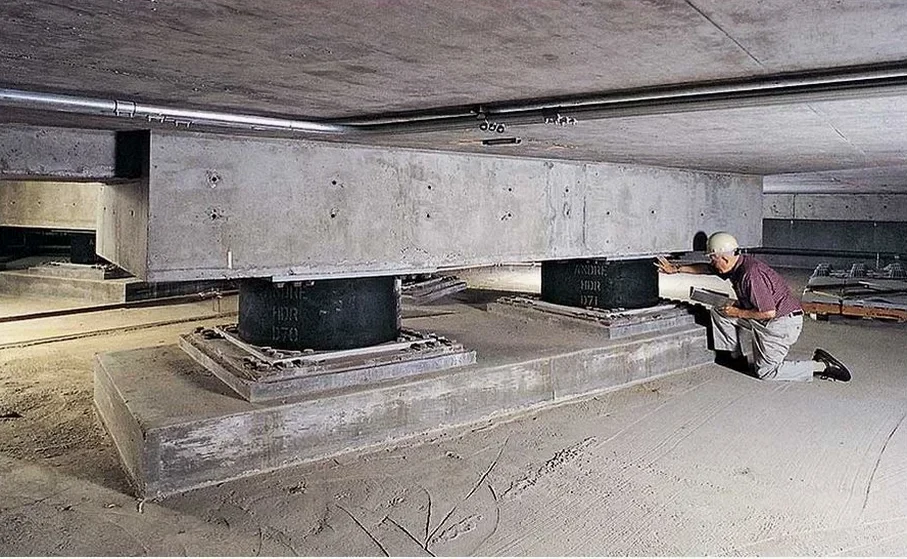
An elastomeric isolator arrives at the yard in a shipping frame, still marked with the batch cure date from the factory. Before it ever touches a St. Catharines foundation, the design file behind it has already reconciled three hundred years of regional seismicity with the specific column grid of a building sitting on glacial till. That reconciliation is what our laboratory team lives in every day: we take the accelerograms that matter for the Niagara Peninsula, run them through nonlinear time-history models, and produce isolator property sets that will keep a structure serviceable when the ground moves. The process is less about the bearing itself and more about how the soil at the site, often the stratified silty clay that underlies much of downtown St. Catharines, will amplify or damp incoming waves before they reach the isolation plane. When combined with a CPT test to map the stiffness profile, the design can be tuned precisely to the subsurface conditions.

An isolator that works in July must also work in January; the Lake Ontario snowbelt does not negotiate on temperature.

Our service areas

Our approach and scope

The freeze-thaw cycling that St. Catharines sees from November through March introduces a design consideration that warmer seismic zones never face: isolator performance must be verified across a temperature range that can swing from minus twenty to plus thirty-five Celsius within a single season. High-damping rubber bearings, the workhorse for mid-rise construction in the region, change their effective stiffness noticeably at low temperatures, so the design iteration has to bracket both the summer and winter dynamic properties when running the modal analysis. Lead-rubber bearings add another variable because the lead core yield force shifts with temperature as well. The design workflow we follow loops through these thermal cases against the NBCC 2020 spectral demands, and if the displacement demand exceeds the isolator capacity at cold temperatures, the solution is rarely a bigger bearing; more often it is adjusting the stone columns beneath the foundation to stiffen the soil-isolator interface and reduce the period shift that drives the demand up.
Base Isolation Seismic Design for St. Catharines Structures
Technical reference — St. Catharines

Local geotechnical context

The Queenston Shale and the overlying glacial stratigraphy that define the subsurface across much of St. Catharines carry a specific risk for base-isolated buildings: the impedance contrast between the stiff shale and the softer lacustrine silts can trap seismic energy near the surface, producing a basin-edge amplification effect that standard site-class amplification factors underestimate. When the isolation period lands within the amplified band, the displacement demand on the bearings can exceed code-minimum estimates by twenty to thirty percent. Catching this requires a site-specific ground response analysis, not just the NBCC table values, and it is that analysis that often drives the decision to add supplemental viscous damping or to modify the isolator layout from a uniform grid to a perimeter-concentrated arrangement. In St. Catharines, where the shale is shallower on the south side of the city near the escarpment and deeper toward Lake Ontario, the risk profile shifts block by block, and a generic design approach leaves gaps that neither the contractor nor the owner can afford.

Need a geotechnical assessment?

Reply within 24h.

Email: info@geotechnicalengineering.co

Relevant standards

NBCC 2020 (National Building Code of Canada), Part 4, Division B, for seismic design provisions and isolator testing protocols, CSA A23.3: Design of Concrete Structures, for anchorage of isolators to reinforced concrete foundations, CSA S6: Canadian Highway Bridge Design Code, referenced for isolator property verification methods applicable to building projects, ASTM D4014: Standard Specification for Plain and Steel-Laminated Elastomeric Bearings for Bridges, used as supplementary guidance for elastomeric isolator quality control

Technical parameters

ParameterTypical value
Design spectral acceleration at 0.2 s (St. Catharines, Site Class C)0.42 g per NBCC 2020 hazard values for the Niagara region
Effective period range after isolation2.5 s to 3.8 s, targeting a shift away from the 0.1–0.5 s soil amplification band
Isolator types specifiedHigh-damping rubber bearings (HDRB) and lead-rubber bearings (LRB), both with CSA A23.3-compliant anchor design
Temperature envelope for property sets-20 °C to +40 °C, incorporating St. Catharines winter lows and solar gain on exposed isolators
Minimum restoring force ratio≥ 0.025 per NBCC Clause 4.1.8.17, verified across all temperature-property sets
Maximum residual displacement≤ 20 mm after MCE-level event, checked via seven-pair time-history analysis
Foundation type most paired with isolationReinforced concrete mat, often with perimeter frost walls keyed below 1.2 m depth
Peer review requirementIndependent third-party review per NBCC for all post-disaster and high-importance category buildings

Questions and answers

What does base isolation design cost for a typical St. Catharines building?

For a mid-rise structure in the St. Catharines area, the full scope of isolator property design, nonlinear time-history analysis, and construction-phase support typically falls between CA$5,280 and CA$12,670. The range depends on the number of isolators, the complexity of the superstructure, and whether a site-specific ground response analysis is required to capture the basin-edge effects common in the Niagara Peninsula.

How does the NBCC 2020 govern base isolation design in Canada?

NBCC 2020 Clause 4.1.8.17 and the commentary in the Structural Commentaries set out the requirements for base-isolated structures, including the lower-bound and upper-bound property approach, the restoring force criterion, and the peer review mandate for post-disaster buildings. The code also references the need for prototype testing and specifies that the isolation system must be designed for both the design-basis and the maximum-considered earthquake levels.

What type of building in St. Catharines benefits most from base isolation?

Buildings with high occupancy, critical post-earthquake function, or expensive non-structural contents see the strongest return on isolation in St. Catharines. Hospitals, emergency response centers, data centers, and university research facilities are typical candidates because the isolation plane protects not just the structural frame but also the mechanical, electrical, and plumbing systems that are costly to repair. The moderate seismicity of the region makes isolation a viable alternative to conventional ductile design when operational continuity after an event matters.

Is a site-specific seismic hazard analysis always required for base isolation in St. Catharines?

Not always, but it is strongly recommended when the site sits on the variable glacial stratigraphy that characterizes much of St. Catharines. The NBCC provides uniform hazard spectra for the region, but the basin-edge amplification that occurs where the Queenston Shale shallows near the escarpment can produce spectral accelerations that deviate meaningfully from the code values. A site-specific analysis resolves that uncertainty and often refines the isolator displacement demands enough to avoid overdesign.

Location and service area

We serve projects in St. Catharines and surrounding areas.

View larger map