GEOTECHNICALENGINEERING
ST. CATHARINES
HomeRoadwayFlexible pavement design

Flexible Pavement Design for Niagara’s Glacial Soils

Practical geotechnics, field-tested.

LEARN MORE

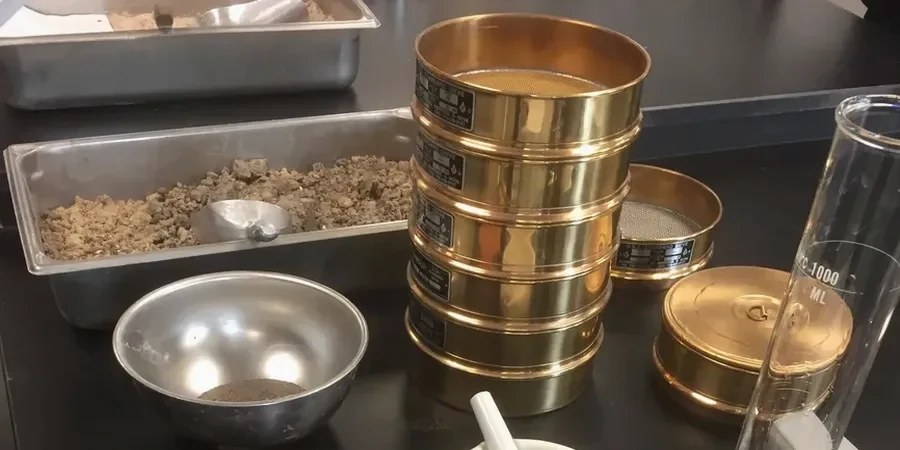
The soil under Port Dalhousie Road is nothing like the compact till north of the escarpment. Near the lake, silty clay dominates—high moisture, low strength. Move south toward the Niagara Escarpment and you hit glacial till with sand lenses and fractured shale. A pavement section that works in one area will rut in the other within two seasons. We design flexible pavement structures that match the actual subgrade conditions across St. Catharines. CBR testing, frost susceptibility analysis, and layer coefficient calibration are standard in every project. Before asphalt goes down, we confirm the granular base and subbase thickness with field data. For low-volume roads over soft clay, we often recommend a stabilization layer or geogrid reinforcement evaluated alongside the CBR road design methodology.

A pavement designed without frost-depth data in St. Catharines will fail at the subgrade level within the first two freeze-thaw cycles.
Our service areas

Our approach and scope

The Falling Weight Deflectometer trailer moves through St. Catharines streets early morning, dropping a segmented weight onto the pavement surface and recording deflection basins at seven sensors. The data feeds back-calculation software that extracts layer moduli for asphalt, granular base, and subgrade—no coring needed. Temperature corrections are applied using mid-depth pavement temperatures logged on-site. Deflection data gets matched against traffic projections from the Region of Niagara’s AADT counts. For new construction, we use laboratory CBR values from soaked samples compacted at optimum moisture. The structural number is calculated per AASHTO 1993, then layer coefficients are assigned based on Ontario Provincial Standards for hot-mix asphalt, granular A, and granular B Type II. Seasonal adjustment factors account for the spring thaw weakening period that hits St. Catharines every March and April when the frost leaves the ground.
Flexible Pavement Design for Niagara’s Glacial Soils
Technical reference — St. Catharines

Local geotechnical context

St. Catharines sits between two Great Lakes, and the humidity from Lake Ontario and Lake Erie keeps subgrade moisture high well into June. The frost penetrates deeper here than in Toronto—up to 1.2 meters in open areas. When that frost melts, the subgrade becomes saturated and loses bearing capacity for weeks. A pavement section designed with summer CBR values will heave in winter and rut in spring. We test subgrade samples at worst-case moisture conditions: soaked CBR after 96-hour immersion. The Niagara Escarpment adds another variable—roads built on shale fill can develop differential settlement if the fill wasn’t compacted in thin lifts. Our designs include a separation geotextile between subgrade and granular base wherever fines content exceeds 15%. For industrial yards with heavy forklift traffic, we increase the granular base thickness beyond the AASHTO minimum and specify a stiffer asphalt binder grade to resist summer rutting under standing loads.

Need a geotechnical assessment?

Reply within 24h.

Email: info@geotechnicalengineering.co

Relevant standards

AASHTO 1993 Guide for Design of Pavement Structures, ASTM D1883 Standard Test Method for California Bearing Ratio, Ontario Provincial Standard Drawings (OPSD 3090.100), ASTM D4694 Standard Test Method for Deflections with Falling-Weight-Type Impulse Load Device

Technical parameters

ParameterTypical value
Design standardAASHTO 1993 Guide for Design of Pavement Structures
Subgrade strength inputSoaked CBR (ASTM D1883) at 95% standard Proctor
Frost depth design1.2 m typical for St. Catharines (OPSD 3090.100)
Traffic loadingESALs computed from AADT and vehicle class distribution
Layer coefficientsa1=0.42 HMA, a2=0.14 Granular A, a3=0.10 Granular B Type II
Drainage coefficientm=1.0 to 0.80 depending on moisture exposure and time to drain
Reliability levelR=85% for collector roads, R=95% for arterial roads
Serviceability lossΔPSI = 1.7 to 2.0 depending on functional classification

Questions and answers

What subgrade CBR value is typical in St. Catharines?

It varies dramatically. Glacial till south of the escarpment can yield CBR values of 8–15%. Silty clay near Lake Ontario, especially in the Port Dalhousie and Lakeshore Road areas, often tests at 2–4% soaked CBR. We always run multiple CBR tests per site because the variability across short distances is significant.

How much does flexible pavement design cost for a parking lot in St. Catharines?

Design fees range from CA$2,210 to CA$8,100 depending on lot size, traffic loading, subgrade complexity, and whether FWD testing is needed. A small commercial lot with straightforward geotechnical conditions falls toward the lower end. A heavy-duty industrial yard with poor subgrade and high ESALs requires more analysis and moves toward the upper range.

Do you account for frost action in the pavement design?

Yes. St. Catharines frost depth reaches 1.2 meters, and the spring thaw lasts several weeks. We design the total pavement thickness to exceed the frost penetration depth or include a non-frost-susceptible granular layer that prevents capillary rise. Soaked CBR testing and seasonal adjustment factors from AASHTO are standard in every design we produce.

What traffic data do you need for the design?

We need the average annual daily traffic (AADT) and the percentage of trucks. For commercial and industrial projects, we also need the expected number of heavy vehicle passes per day. If AADT data isn’t available, we can estimate ESALs from the site’s intended use and the Region of Niagara’s vehicle class distribution tables.

Location and service area

We serve projects in St. Catharines and surrounding areas.

View larger map