GEOTECHNICALENGINEERING
ST. CATHARINES
HomeInvestigationCPT (Cone Penetration Test)

CPT Testing in St. Catharines — Cone Penetration for Niagara Soils

Practical geotechnics, field-tested.

LEARN MORE

Around St. Catharines, the ground doesn't read the textbook. You get stiff Halton Till sitting over soft glaciolacustrine silts, then the Queenston shale somewhere underneath. A standard borehole log can miss that thin drainage layer that changes your footing design completely. That's why we lean on CPT here. The cone gives you a continuous vertical profile — tip resistance, sleeve friction, pore pressure — all in one push. You see the transition zones in real time, not just at 1.5-metre intervals. For a city sitting right on the Niagara Escarpment slope, knowing exactly where the weak seam sits matters more than people realize. We run the rig, you get the qc plot, and the stratigraphy actually makes sense.

CPT captures a soil transition at 2 cm resolution — a borehole log might miss it entirely.
Our service areas

Our approach and scope

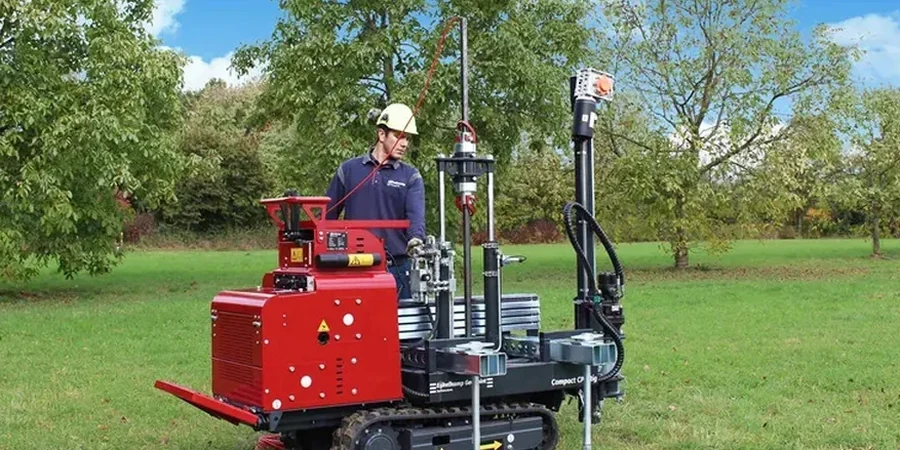
The rig we use in St. Catharines is a 20-tonne tracked unit that can push through dense till without pre-drilling — most of the time. It's equipped with a 15 cm² electronic cone, full piezocone capability, and automatic data logging at 2 cm intervals. That's the key: the resolution lets you spot thin sand lenses in the clay that a split-spoon sampler would smear right past. On jobs near the old Welland Canal or down by Port Dalhousie, we often pair the CPT with a shear wave velocity profile to get a full picture of soil stiffness. And when the clay is too sensitive for undisturbed sampling, the pore pressure dissipation test during CPT tells us the consolidation coefficient — without a lab oedometer. For fill areas, we sometimes cross-check with a sand cone density test to confirm compaction levels before the cone goes in.
CPT Testing in St. Catharines — Cone Penetration for Niagara Soils
Technical reference — St. Catharines

Local geotechnical context

St. Catharines sits at roughly 98 metres elevation on the Niagara Escarpment slope, and the 2022 MCE scenario for southern Ontario puts peak ground acceleration around 0.15–0.25g depending on site class. The Halton Till can be stiff, but the underlying glaciolacustrine silts and clays are prone to cyclic softening. A standard SPT-based site class assignment can overestimate stiffness if it misses a thin soft layer. CPT gives you a direct measurement of shear wave velocity — not a correlation from blow counts — so your seismic site classification under NBCC 2015 actually reflects the ground you're building on. Skip the CPT and you might be classifying Site D as Site C without knowing it.

Need a geotechnical assessment?

Reply within 24h.

Email: info@geotechnicalengineering.co

Relevant standards

NBCC 2015 (National Building Code of Canada), CSA A23.3-14 (Design of Concrete Structures), ASTM D5778-20 (Standard Test Method for Electronic Friction Cone and Piezocone Penetration Testing of Soils)

Technical parameters

ParameterTypical value
Cone capacity50 MPa (sleeve), 100 MPa (tip)
Penetration depth (typical)15–25 m in overburden
Measurement interval20 mm (continuous)
Pore pressure transducer2 MPa range, u2 position
Friction sleeve area150 cm²
Data outputqc, fs, u, Rf, Bq, SBTn

Questions and answers

What does a CPT test cost in St. Catharines?

Standard CPTu profiling in St. Catharines runs between CA$260 and CA$360 per push, depending on depth and whether we need to pre-drill through fill or asphalt. SCPTu with shear wave adds a bit more per test interval. We quote per day with a minimum mobilization, which usually makes more sense if you have multiple locations. Reach out for a site-specific number.

How deep can CPT go in Niagara soils?

In the Halton Till we typically reach 15–20 metres before encountering refusal on boulders or shale bedrock. In the softer glaciolacustrine silts near the lake plain, depths of 25 metres are common. We stop when the tip resistance exceeds 50 MPa consistently — forcing beyond that risks damaging the cone.

Do you need a borehole alongside CPT?

Not always. CPT gives you continuous soil behaviour type from the SBTn chart, but it doesn't retrieve a physical sample. If you need exact grain size or Atterberg limits to confirm classification, we recommend pairing at least one borehole or test pit with the CPT program.

Can CPT detect liquefiable layers?

Yes, that's one of the main reasons we run it. The cone measures tip resistance and pore pressure directly. We apply the Robertson method to estimate factor of safety against liquefaction for different earthquake magnitudes. In St. Catharines, the saturated silts below the water table are the layer we screen most carefully.

How long does a CPT program take on site?

A single push to 20 metres takes about 30–45 minutes of actual penetration time. With rig setup, dissipation tests, and moving between locations, we typically complete 8–12 pushes in a standard day on a cleared St. Catharines lot.

Location and service area

We serve projects in St. Catharines and surrounding areas. More info.

View larger map