GEOTECHNICALENGINEERING
ST. CATHARINES

Geotechnical Engineering in St. Catharines

Practical geotechnics, field-tested.

LEARN MORE

St. Catharines grew along the foundation of the old Welland Canals, where early engineers quickly learned that the city’s glacial history left behind a complicated subsurface. The retreat of the Wisconsin ice sheet deposited layers of silty clay, glacial till, and pockets of sand that today define the foundation conditions across the Garden City. Every soil mechanics study we review in St. Catharines has to account for these deep glaciolacustrine sequences, particularly in older neighborhoods near the Twelve Mile Creek valley where buried stream channels can introduce unexpected soft zones. A thorough investigation examines stratigraphy, shear strength, and consolidation potential before any structural load is applied. When the site conditions demand it, we often integrate data from the CPT test to obtain a continuous profile of tip resistance and sleeve friction, which helps identify thin weak seams that traditional boreholes might miss. Understanding this geology is not a formality in St. Catharines; it is the difference between a foundation that settles uniformly and one that distorts within the first five years.

St. Catharines sits on a glaciolacustrine plain where soft clays and buried sand lenses demand a careful geotechnical interpretation before any foundation design proceeds.
Geotechnical Engineering in St. Catharines
Technical reference — St. Catharines

Our service areas

Local geology

The National Building Code of Canada and CSA A23.3 establish the baseline for geotechnical investigations, yet in a city with such variable overburden, merely meeting the minimum standard is rarely enough. A proper soil mechanics study in St. Catharines must characterize the lacustrine clays for compressibility, determine the preconsolidation pressure through incremental oedometer testing, and assess the sensitivity of the silty matrix when saturated. During the spring melt, groundwater levels rise dramatically in the lower-lying sections between Lake Ontario and the Escarpment, temporarily reducing effective stress and altering the bearing response. Our laboratory program typically includes consolidated undrained triaxial tests to capture the undrained shear strength of these deposits under realistic in-situ stress paths. For sites with marginal allowable bearing capacity, we evaluate ground improvement strategies such as vibrocompaction to densify loose granular layers that frequently appear at depths of five to nine meters in the north end of the city.

Relevant standards

NBCC 2020 – Division B, Section 4.2 (Foundations), CSA A23.3:19 – Design of Concrete Structures (Foundation Requirements), ASTM D1586 – Standard Penetration Test (SPT) and Split-Barrel Sampling, ASTM D4767 – Consolidated Undrained Triaxial Compression Test for Cohesive Soils, ASTM D2435 – One-Dimensional Consolidation Properties of Soils

Need a geotechnical assessment?

Reply within 24h.

Email: info@geotechnicalengineering.co

Explanatory video

Why choose us

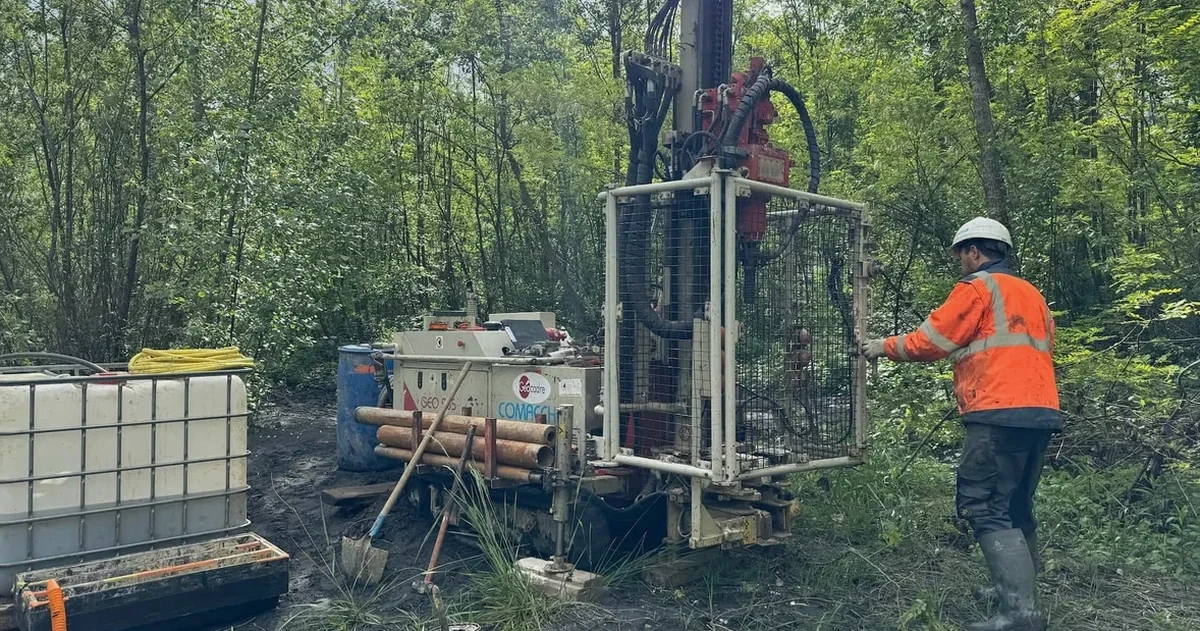
A mid-rise residential project on Scott Street encountered a shallow buried valley filled with organic silt that had not appeared on the regional Quaternary maps. The initial boreholes terminated in what was presumed to be competent till, but a cone penetration test revealed a five-meter-deep pocket of highly compressible material directly beneath the proposed elevator shaft. Without this deeper investigation, differential settlement would have cracked the masonry within the first two years of occupancy. In St. Catharines, the interaction between the stiff Halton Till and the softer glaciolacustrine deposits creates a contact zone that concentrates stress and amplifies settlement gradients. When the site is near one of the city’s many creeks, the risk of lateral spreading during a seismic event also enters the design conversation, requiring a careful evaluation of cyclic resistance ratios. A rigorous soil mechanics study catches these conditions before the concrete is poured.

Technical parameters

ParameterTypical value
Typical Depth to Glacial Till8 to 18 meters
Undrained Shear Strength (Su) of Silty Clay25 to 70 kPa
Consolidation Coefficient (Cv)0.5 to 2.5 m²/year
Standard Penetration Resistance (N-value) in Till15 to >50 blows
Seasonal Groundwater Fluctuation1.2 to 2.8 meters
Soil Resistivity (Silty Clay)1,500 to 4,500 ohm-cm
Bearing Capacity (Spread Footing on Stiff Till)200 to 350 kPa (ULS)

Questions and answers

How long does a soil mechanics study take in St. Catharines?

A typical investigation takes three to four weeks from the start of field drilling to the delivery of the final report. Laboratory consolidation and triaxial tests require about two weeks for the clay samples to reach full saturation and undergo staged loading, so the overall timeline depends on the complexity of the stratigraphy and the number of samples recovered.

What standards does a soil mechanics study in Ontario follow?

The study follows the National Building Code of Canada (NBCC 2020), CSA A23.3 for concrete foundations, and relevant ASTM standards for laboratory testing such as D4767 for triaxial compression and D2435 for consolidation. The Ontario Building Code also references these documents and requires a professional engineer to seal the geotechnical report.

What is the cost range for a soil mechanics study in St. Catharines?

For a standard residential or light commercial lot in St. Catharines, the cost typically ranges from CA$4,450 to CA$6,700, depending on the number of boreholes, the depth of investigation, and the specific laboratory tests required to characterize the glaciolacustrine deposits.

Do I need a soil mechanics study for a small addition to my house?

Yes, even a single-story addition benefits from a geotechnical evaluation in St. Catharines. The expansive silty clays and variable fill in older neighborhoods can cause differential movement between the existing structure and the new addition if the foundation is not designed for the specific ground conditions.

What happens if the soil in my St. Catharines lot is too soft for a conventional footing?

If the bearing capacity is insufficient, we typically evaluate deeper foundations such as drilled shafts socketed into the competent till or bedrock, or ground improvement techniques like rigid inclusions. The solution depends on the thickness of the soft layer and the structural loads, but almost every site in the city has a viable engineering solution.

Location and service area

We serve projects in St. Catharines and surrounding areas.

View larger map