GEOTECHNICALENGINEERING
ST. CATHARINES
HomeSlopes & WallsRetaining wall design

Retaining Wall Design in St. Catharines: Geotechnical Constraints and Solutions

Practical geotechnics, field-tested.

LEARN MORE

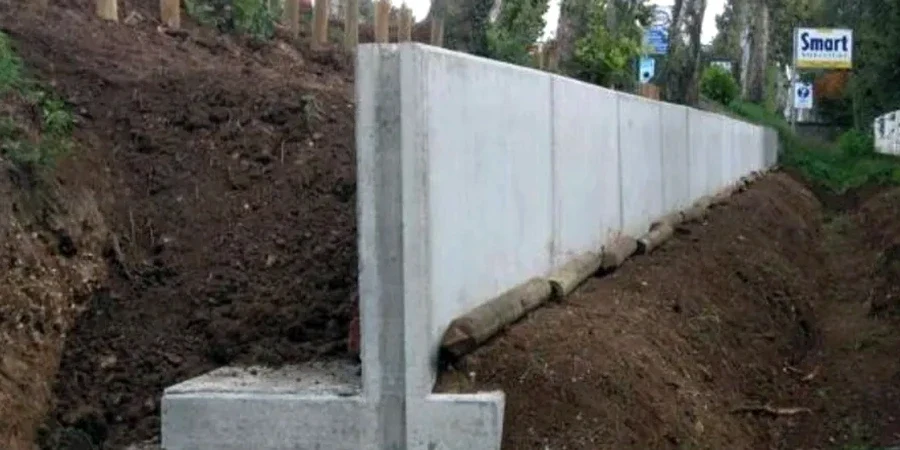
A common mistake in St. Catharines is treating a retaining wall as a standard gravity box without probing the underlying stratigraphy first. The city sits on the brow of the Niagara Escarpment, underlain by the Queenston Formation shale and overconsolidated Halton Till. These materials behave differently under lateral stress, and a wall keyed just 30 cm too shallow into weathered shale can rotate within two freeze-thaw cycles. We see this pattern often in residential cuts along Glenridge Avenue and in commercial fills near the Fourth Avenue corridor. To avoid surprises during excavation, many local contractors now pair the wall analysis with an in-situ permeability test to verify drainage assumptions behind the stem, since perched water in the till is more common than borehole logs suggest.

St. Catharines walls fail more often from uncontrolled groundwater than from structural overload, a fact the local till geology reinforces every spring.

Our service areas

Our approach and scope

In St. Catharines, many failed wall designs we review share one oversight: assuming drained conditions in the upper 2 metres of clayey silt till. The Halton Till here has a matrix-dominated fabric with occasional sand lenses that trap water against the back of the wall, building pore pressures the original drainage plan never accounted for. A proper design sequence therefore starts with spt-drilling to confirm refusal depth and N-values, followed by laboratory grain-size analysis to classify the backfill and retained soil. We then apply either a Coulomb wedge or a log-spiral limit equilibrium model, depending on whether the failure surface is planar or will curve around a weak seam. Key design inputs include the long-term effective friction angle of the foundation stratum, the interface friction between the base and the shale or till, and the seasonal high groundwater table mapped from piezometer records in the Niagara Peninsula watershed.
Retaining Wall Design in St. Catharines: Geotechnical Constraints and Solutions
Technical reference — St. Catharines

Local geotechnical context

St. Catharines grew along the Welland Canal terraces and later climbed the escarpment slopes, leaving a legacy of cut-and-fill lots where the fill is often undocumented and poorly compacted. When a retaining wall is placed on a bench cut into the escarpment, differential settlement between the natural shale and the adjacent fill can crack the wall within the first year. The risk compounds in older neighborhoods like Yates Street or near the former canal locks, where historical maps show buried ravine lines now infilled with heterogeneous debris. A slope stability review using slope-stability methods becomes essential if the wall supports a surcharge within a 1:1 influence zone from the crest. We also check for global instability along weak Queenston shale bedding planes dipping toward the excavation, a failure mode documented in several Niagara-region case studies.

Need a geotechnical assessment?

Reply within 24h.

Email: info@geotechnicalengineering.co

Relevant standards

NBCC 2020 (National Building Code of Canada), CSA A23.3:19 (Design of Concrete Structures), CSA S6:19 (Canadian Highway Bridge Design Code – retaining wall sections), ASTM D6913 (Grain-size analysis of backfill materials), MTO OPSD 3090.100 (Proprietary retaining wall systems, Ontario)

Technical parameters

ParameterTypical value
Design life (per NBCC Table 4.1.2.2)50 years (Normal importance category)
Seismic hazard (Sa 0.2, Class C site)0.32–0.41 g per NBCC 2020
Base friction, concrete on Queenston shale0.55–0.65 (peak, lab shear test)
Frost penetration depth (St. Catharines region)1.2 m (per OPSD frost criteria)
Backfill drainage coefficient (k)≥ 3 × 10⁻⁵ m/s for free-draining granular
Minimum stem thickness (cantilever wall, CSA A23.3)200 mm above frost line
Bearing capacity factor Nc (undrained, till)5.14 (Skempton, D/B < 2)

Questions and answers

What is the typical cost range for a retaining wall design in St. Catharines?

For a standard cantilever or gravity wall up to 3.5 metres in height, the design package (geotechnical investigation, structural calculations, and stamped drawings) typically ranges from CA$1,620 to CA$6,160. The final figure depends on the wall length, the complexity of the subsurface profile, and whether a slope stability assessment is required under the Ontario Building Code.

How does the Queenston shale affect retaining wall design in St. Catharines?

Queenston shale is a weak, thinly bedded sedimentary rock that weathers rapidly when exposed to air and water. In retaining wall design, we treat the upper 0.5–1.0 metre as a transitional weathered zone with reduced shear strength. Key concerns include progressive slaking at the base cut, anisotropic strength along bedding planes, and the need to protect the excavation floor with a mud slab immediately after trimming.

Do I need a building permit for a retaining wall in St. Catharines?

Yes, the City of St. Catharines Building By-law requires a permit for any retaining wall exceeding 1.0 metre in height, measured from the bottom of the footing to the top of the wall. Walls supporting a surcharge (such as a driveway or a neighboring structure) may require a professional engineer's design and a geotechnical report regardless of height, per the Ontario Building Code Part 4.

Location and service area

We serve projects in St. Catharines and surrounding areas.

View larger map